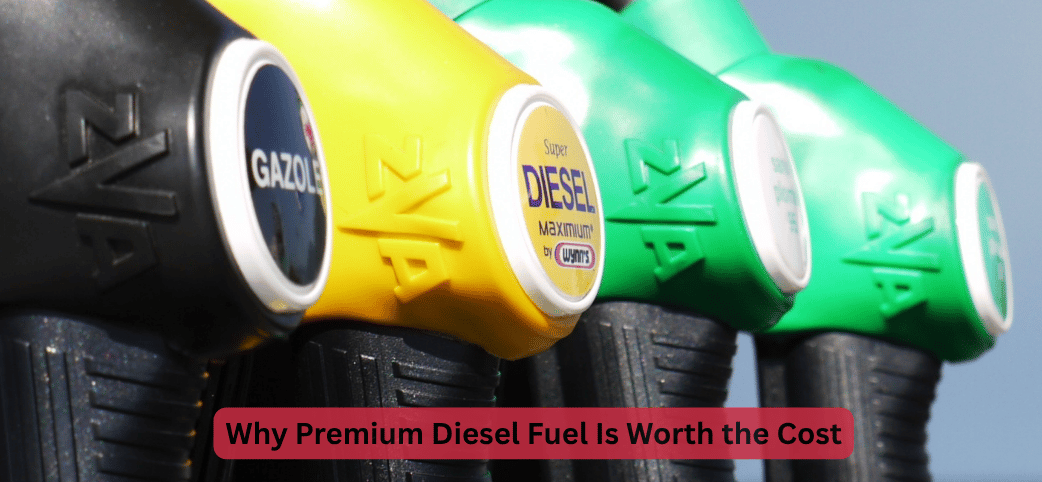
Premium diesel can be worth the extra cost when it meets your equipment’s fuel requirements, provides verifiable quality and helps you avoid contamination-related maintenance and downtime. The value comes from the product and service you receive, rather than the word “premium” on the quotation.
At Buy Diesel Direct, we use premium-grade diesel to describe our quality-controlled, unadulterated 50ppm diesel. Our focus is dependable sourcing and delivery of the agreed fuel specification. We do not promise that switching fuel will automatically increase horsepower or reduce consumption by a fixed percentage.
For a fleet operator, farmer or construction contractor, the practical question is whether the extra fuel cost delivers measurable value across the operation. To answer that, you need to understand sulphur content, fuel cleanliness, additives and your manufacturer’s requirements. Are you looking for top quality 50 PPM diesel?
What Does Premium Diesel Actually Mean?
Premium diesel is a supplier’s product description. Different suppliers may use it for different combinations of fuel properties, additive packages or quality-assurance measures.
Before paying extra, ask what distinguishes the product from another compliant diesel of the same sulphur grade. A premium label alone does not establish better detergency, higher cetane quality or improved fuel economy.
Low-Sulphur Diesel
The 50ppm designation refers to a maximum sulphur concentration of 50 parts per million. A 500ppm grade permits a maximum of 500 parts per million.
That makes the permitted sulphur limit for 50ppm diesel one-tenth of the limit for 500ppm diesel. Lower sulphur helps reduce sulphur-related emissions and supports equipment designed to operate on lower-sulphur fuel.
However, sulphur content does not tell you whether diesel contains water, dirt or microbial contamination. It also does not establish the fuel’s lubricity or cleaning performance.
Read our latest blog: How Weather Affects Diesel Fuel Performance
Additive-Enhanced Diesel
Some premium products contain additional detergents, cetane improvers, lubricity improvers or other additives designed for specific purposes.
A suitable detergent package may help control injector deposits. Other additives can address different fuel properties, but their benefits depend on the formulation, dose and application.
Do not assume that every premium-labelled fuel contains an enhanced additive package. Ask the supplier what is included and what evidence supports its claims.
Adding a treatment to 500ppm diesel does not turn it into 50ppm diesel by removing its sulphur.
Clean, Compliant Diesel
Cleanliness concerns water, particles and other contamination. Compliance concerns whether the fuel meets the applicable specification.
A fuel can have low sulphur and still become contaminated during transport or storage. Conversely, properly handled diesel should not be considered poor quality simply because it is sold without a premium label.
At Buy Diesel Direct, our emphasis on unblended fuel means no unauthorised dilution or adulteration after sourcing. It does not mean that legitimate refinery formulation or specification-compliant additives are inherently undesirable.
Why Fuel Quality Matters to Your Equipment
Fuel reaches components that depend on tightly controlled operating conditions. Water, abrasive particles and unsuitable fuel properties can affect pumps, injectors and combustion.
Repeated filter blockages are often an early warning. Changing filters may restore operation temporarily, but the underlying contamination still needs investigation.
Protecting Fuel Systems
Modern high-pressure fuel systems need fuel that meets the manufacturer’s requirements for cleanliness, lubricity and other properties.
Low sulphur alone does not protect an injector from dirt or water. It also does not guarantee adequate lubrication. Properly formulated diesel must meet the relevant requirements across the specification.
Our advice is to buy verifiable fuel suited to your equipment and protect its condition all the way from delivery to the engine.
Protecting Exhaust After-Treatment Systems
Engines fitted with exhaust after-treatment can have strict sulphur limits. Using the wrong grade may affect system operation, emissions compliance and warranty eligibility.
Do not assume that 50ppm diesel suits every modern engine. Some equipment requires fuel with a maximum sulphur content of 10ppm or 15ppm.
Check the manual for the specific engine model and market configuration. If the requirement is unclear, obtain confirmation from the manufacturer or dealer before ordering.
Does Premium Diesel Improve Fuel Economy?
There is no universal fuel-economy improvement that applies whenever you switch to premium diesel.
If an engine has suffered from deposits or unsuitable fuel, correcting the problem may help recover lost performance. A proven detergent formulation may also help maintain injector cleanliness in suitable applications.
Those benefits should not be confused with making a healthy engine exceed its normal performance simply by lowering sulphur content.
Fuel consumption also changes with:
- Vehicle load and route.
- Driver behaviour and idling.
- Equipment workload and operating hours.
- Tyre condition and pressure.
- Engine maintenance and mechanical condition.
- Generator load and operating pattern.
Measure consumption under comparable conditions before claiming a saving. For trucks, track litres per 100 kilometres alongside load and route information. For working equipment, litres per hour should be considered together with the work completed.
A Contractor Example: Filter Costs Fell After Fuel and Tank Problems Were Addressed
One Gauteng civil-engineering contractor described in our experience operated Caterpillar excavators, Bell dump trucks and Deutz generators.
The contractor experienced severe contamination associated with an unverified fuel supply. The reported problems included paraffin adulteration and microbial sludge in the storage system.
Filters were lasting approximately 80 operating hours, and monthly filter expenditure had reached around R60,000.
What Changed?
The response involved switching to verified diesel and cleaning the contractor’s 10,000-litre storage tank.
After those interventions, reported filter life increased to as much as 500 hours, while monthly filter expenditure fell to approximately R12,000.
That represents a reported reduction of R48,000 a month, or 80% of the previous filter expenditure.
What This Example Demonstrates
The improvement followed both a fuel-supply change and tank cleaning. It would be misleading to attribute the entire saving to 50ppm sulphur content or to promise the same result to every customer.
This was a contamination-recovery example. It was not a controlled comparison between two clean, compliant fuels.
The practical lesson is that paying for verified fuel and addressing contaminated storage can cost less than repeatedly replacing filters while the source of the problem remains unresolved.
The reported 500-hour filter life is also not a general replacement recommendation. Your equipment’s maintenance schedule and operating conditions determine the appropriate interval.
How to Calculate Whether the Extra Cost Is Worth It
At Buy Diesel Direct, we encourage customers to compare total operating cost rather than focusing only on the price per litre.
Start with the additional fuel expenditure, then compare it with evidenced maintenance, downtime and consumption savings.
Calculate the Annual Fuel Premium
Multiply your annual diesel consumption by the price difference per litre.
For example, an operation using 20,000 litres per month consumes 240,000 litres annually. If the chosen product costs R0.40 more per litre, the additional annual expenditure is R96,000.
Use complete delivered prices on the same VAT basis. Include transport charges and any other applicable fees.
Calculate Measurable Savings
Review your records for changes in:
- Fuel-filter expenditure.
- Fuel-pump and injector repairs.
- Unscheduled workshop labour.
- Equipment downtime and replacement hire.
- Delivery penalties or lost production.
- Fuel consumption under comparable operating conditions.
Only count savings you can reasonably support. Do not assume that every previous repair will disappear after changing suppliers.


Compare the Totals
Your estimated net annual benefit is the maintenance, downtime and fuel-consumption savings, less the additional annual fuel cost.
As an illustrative calculation, suppose the operation paying an extra R96,000 annually records R72,000 in maintenance savings and R48,000 in reduced downtime costs. With no assumed fuel-economy benefit, the estimated net annual benefit is R24,000.
This calculation is an example, not a forecast. Keep downtime and lost-production estimates separate where necessary to avoid counting the same saving twice.
When Is Paying More Justified?
When the Fuel Meets a Required Specification
If your manufacturer requires a particular sulphur limit or fuel specification, meeting that requirement comes first. The decision is not simply whether a cheaper grade appears to run the engine.
Using compliant fuel supports correct operation, but it does not guarantee that the engine will achieve its maximum possible service life. Maintenance, workload and operating conditions remain important.
When Quality Assurance Reduces a Meaningful Risk
For a construction project or critical generator installation, a fuel-related stoppage can have consequences far beyond a repair bill.
Traceable sourcing, appropriate testing, controlled handling and dependable replenishment can provide value where continuity matters.
Ask exactly which of those measures the supplier provides. A higher price should come with a clear explanation of the product and service.
When Your Current Supply Has Confirmed Problems
Repeated filter failures, water contamination or laboratory-confirmed adulteration justify prompt investigation.
Changing to suitable fuel may be necessary, but contaminated tanks, pipework and equipment also need attention. Fresh diesel poured into a dirty system can become contaminated again.
When Might Ordinary Diesel Be Sufficient?
If another supplier offers clean, compliant diesel meeting the same equipment requirements, a premium label alone does not justify paying more.
Some older engines may permit 500ppm diesel, subject to their manufacturer’s instructions and applicable operating requirements. Older equipment is still vulnerable to water, particles, poor lubricity and adulteration.
For equipment already running reliably on suitable fuel, ask what measurable difference the premium product offers. Without a distinct formulation, stronger quality controls or better service, the extra cost may provide little additional value.
What Should You Verify Before Paying Extra?
The Exact Product Specification
Confirm the sulphur grade and applicable specification. Ask whether the product includes an enhanced additive package or whether “premium” refers primarily to sourcing and quality assurance.
Meeting SANS 342 and holding a specific SABS certification are different claims. Request documentation supporting whichever claim the supplier makes.
Relevant Quality Evidence
Ask for appropriate quality records and an explanation of how they relate to the supplied fuel.
A Certificate of Analysis should identify the product, relevant sample or batch reference, test information and issuing organisation. A generic report unrelated to your supply provides limited reassurance.
Density and flash-point checks can identify some concerns, but passing those checks does not rule out every form of adulteration. Where a problem is suspected, use a competent laboratory and suitable sampling procedures.
Source and Delivery Controls
Ask where the diesel originates, who transports it and how contamination or product mixing is controlled.
Also check your own receiving system. Tank condition, water ingress, dispensing filters and storage time can affect fuel quality after delivery.
How Buy Diesel Direct Approaches Premium Diesel
At Buy Diesel Direct, our premium-diesel offering centres on unadulterated 50ppm fuel, dependable sourcing and transparent supply arrangements.
We welcome questions about the agreed specification, supporting quality records and independent testing arrangements. We also encourage customers to confirm their equipment requirements before choosing a grade.
Our position is straightforward: you should know what fuel you are buying, how its quality is supported and what your delivery includes. We do not treat a premium label as a promise of automatic fuel savings or extra horsepower.
If you are comparing diesel options, contact Buy Diesel Direct with your equipment details, monthly consumption, location and any current fuel-related problems. We can help you assess a suitable supply proposal and the costs that matter to your operation.